

Rusty Lake’s The Past Within is built around a simple idea: two players see different realities and can only progress by talking to each other. One person plays in the Past, the other in the Future, and the puzzles constantly link what you do on one screen to what changes on the other. On mobile, it lands as a rare co-op point-and-click experience that works well in short sessions, but still rewards careful note-taking and clear communication.
What the game actually is on mobile in 2026
The Past Within is co-op only, meaning you cannot finish it solo. Each player needs their own copy on their own device, and you need a way to communicate in real time (voice call is the simplest). That core requirement shapes everything: the game is less about fast reactions and more about describing symbols, objects, sounds, and tiny changes that might not look important until your partner connects the dots.
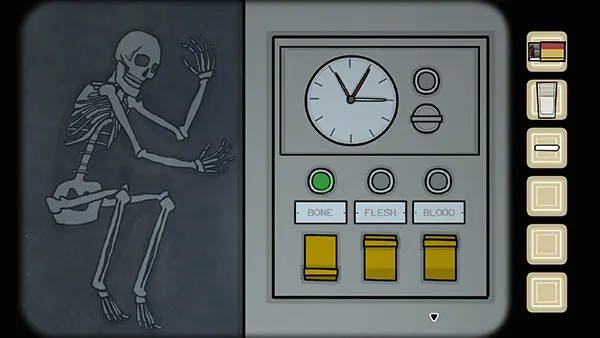
The structure is deliberately split between two perspectives: Past and Future. The environments are different, the interfaces feel different, and many puzzles are designed so that one player can see the “result” while the other can trigger the “cause”. It’s also the title where Rusty Lake plays with 2D and 3D viewpoints as part of the puzzle language, so you will sometimes need to think about depth, angles, and spatial layouts rather than just tapping through screens.
Content-wise, the game is presented in chapters (two main chapters on the store description), with a clear story thread tied to Rusty Lake’s wider Vanderboom narrative. You do not need to memorise the whole series to enjoy it, but returning characters and themes make more sense if you have played at least a few earlier Rusty Lake entries.
Co-op mechanics: how progress is shared and why it works
The game does not demand quick reflexes, but it does demand precision in how you speak. “I see a key” is rarely enough; you’ll do better with “I see a brass key with three notches, beside a dial marked with four symbols”. Many puzzles use patterns, colours, numbers, and iconography that only becomes solvable when both players combine their partial information.
A practical habit that improves the experience is agreeing on a shared vocabulary early on. For example: decide whether you call directions “left/right” based on the screen, or based on an imagined room layout; decide how you describe shapes; and decide whether you read codes from top-to-bottom or left-to-right. These tiny agreements reduce the most common co-op failure: both players being correct, but talking past each other.
Because it is cross-play, you can pair Android with iOS (and, outside mobile, even PC/Mac/Switch depending on what each of you owns). That flexibility is useful, but it also means you should expect slightly different screen sizes and aspect ratios. If something feels “missing”, it is often just tucked behind a scroll, a tap target, or a zoomable view on one device.
Setup, pricing, and what to check before you start
On Android and iOS, the biggest practical point is that both players need a paid copy on their own device. On Google Play, the game is listed as a paid title (for example, it shows $2.99 in the US store), while actual local pricing can vary by region and taxes. If you are planning to play together, it’s worth confirming upfront that both of you can purchase and install it without store restrictions.
In 2026, the easiest setup is still: install the game, choose who plays Past and who plays Future, start a voice call, and keep a pen-and-paper note sheet. You can also use a shared notes app, but writing by hand often wins because it’s faster to sketch shapes, grids, and timelines. If you play remotely, headphones help because several puzzles rely on audio cues and subtle sound effects.
Session planning matters more than people expect. Co-op puzzle games work best when both players have similar energy levels: tired players miss details and become less patient with repeated descriptions. If you want a clean run, treat it like a film night: agree on a time window where neither of you is distracted by notifications or multitasking.
Troubleshooting and “we’re stuck” problems that aren’t bugs
The most common “bug” report is actually a communication mismatch. When you get stuck, pause and do a quick reset: each player re-describes their room from scratch, naming every interactive object and every visible symbol, even if it feels obvious. In this game, “obvious” items are often the trigger for a later step on the other timeline.
If you suspect you missed an interaction on mobile, try systematic taps and drags along edges, drawers, labels, and frames. Rusty Lake games sometimes hide interaction in places that look like decoration at first glance. Also remember that a change caused by your partner might be small (a mark on a panel, a rotated symbol, a newly clickable corner), so it helps to re-check previously “cleared” views after each major action.
Finally, if your co-op flow breaks down, switch roles for one puzzle discussion: let the Past player do most of the questioning, then let the Future player do the questioning. That simple flip often reveals which person is skipping details, and it can bring back momentum without needing external guides.
Why the story and atmosphere land differently in co-op
Rusty Lake has always leaned on surreal, unsettling imagery, but co-op changes how that tone is felt. Because you are constantly describing what you see, you end up “performing” the weirdness to each other. That can make eerie moments funnier, but it can also make them more intense if one player is more sensitive to unsettling themes.
The timeline split is not just a narrative trick; it’s a design method. When the Past player changes an object, the Future player often sees the aftermath and has to interpret it. That cause-and-effect rhythm gives the story weight: you are not simply watching events, you are constructing them together, step by step, through the puzzle logic.
For players who enjoy lore, the game is also a neat entry point to the Vanderboom thread. It references familiar Rusty Lake motifs while still giving enough context inside the game to follow what your immediate goal is, even if you have not played every earlier title.
Who it suits, accessibility notes, and how to get the best experience
This is a strong fit for pairs who genuinely like talking through problems: couples, friends at a distance, or family members who enjoy escape-room style challenges. It is a weaker fit for pairs where one person wants to “drive” and the other wants to stay passive, because the game demands equal participation and equal attention to detail.
On accessibility, the experience can be demanding for players who struggle with tiny visual details or colour-based cues on small screens. If that’s a concern, playing on a tablet for one (or both) players can make a real difference. It also helps to use screen brightness consistently, since subtle contrast changes can hide marks and symbols.
If you want the most satisfying run, resist the urge to rush. Agree to describe first, act second. Keep a shared page of recurring symbols and codes. And when you solve a puzzle, take ten seconds to summarise what just happened in plain language—because later puzzles often reuse the same “grammar” in a new form.