





Many club players assume that rating progress on Chess.com demands hours of daily study. In reality, consistent and well-structured 20-minute sessions can produce measurable improvement over several months. The key is not volume, but precision: knowing what to train, how to review mistakes, and how to turn short practice blocks into long-term rating growth. Below is a practical framework based on how strong improvers train in 2026, using the current Chess.com tools, analytics and competitive formats.
Building a 20-Minute Daily Structure That Works
The most common mistake among improving players is random activity: a few puzzles, then a blitz game, then a video. Progress requires a fixed micro-routine. A proven structure for 20 minutes looks like this: 5 minutes of tactical puzzles, 10 minutes for one focused rapid game (10+0 or 10+5), and 5 minutes for post-game review using Game Review and engine feedback. This balance trains calculation, decision-making under time control, and error correction in one compact block.
On Chess.com in 2026, Puzzle Rating and Rapid Rating are separate ecosystems. Tactical puzzles sharpen pattern recognition, which directly affects blunder rate in rapid games. However, puzzles alone do not improve strategic understanding. That is why at least one serious rapid game per session is essential. Bullet and blitz are entertaining but far less efficient for structured improvement, especially below 1800 rating.
Consistency outweighs intensity. Training 20 minutes daily for 90 days produces far stronger results than two-hour sessions twice a week. Rating systems reward stable performance, and stable performance comes from stable preparation. Short daily exposure also reduces burnout and maintains calculation sharpness.
How to Use Game Review Properly
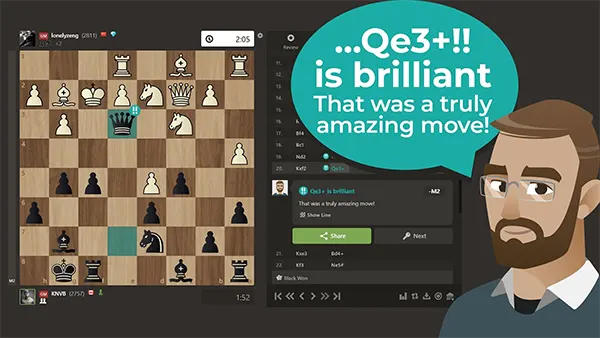
Many players click through engine suggestions without understanding them. Effective review means identifying three things: the first critical mistake, the reason behind it (calculation error, misunderstanding, time pressure), and the alternative plan. Chess.com’s Game Review now categorises mistakes by type, which helps you track recurring weaknesses over time.
Focus on moments labelled as “Missed Win”, “Blunder” or “Inaccuracy in Equal Position”. Instead of memorising engine lines, ask: what did I mis-evaluate? Did I ignore king safety? Did I underestimate a tactical resource? Improvement begins when patterns of error become visible.
Limit review time to five minutes. Over-analysis leads to fatigue. The goal is pattern correction, not perfect play. Over weeks, you will notice fewer repeated mistakes in similar structures, which directly translates into rating stability.
Targeted Skill Development for Real Rating Growth
Not all training brings equal results. For players under 1400 rapid, tactical awareness accounts for most rating swings. Between 1400 and 1800, strategic planning and opening understanding become more relevant. Above 1800, endgame precision and calculation depth matter significantly. Your 20-minute block must reflect your rating bracket.
Chess.com’s Puzzle Rush and Survival modes are useful for speed and pattern recall, but structured rated puzzles are better for long-term growth. Aim for accuracy above 75%, not volume. Solving slowly and correctly strengthens calculation discipline, while guessing damages improvement.
Openings should not dominate your short sessions. Choose one main opening as White and one defence against 1.e4 and 1.d4. Learn typical middlegame plans instead of memorising deep theory. In 2026, Chess.com’s Opening Explorer allows filtering by rating level, which helps you see what actually scores well at your bracket rather than at grandmaster level.
Endgames: The Hidden Rating Booster
Endgames are often neglected because they appear less exciting than tactics. Yet many rapid games at club level are decided in simplified positions. Basic knowledge of king and pawn endings, opposition, rook activity, and conversion technique can add 100–200 rating points over time.
Dedicate one session per week entirely to endgames. Chess.com Lessons and Practice positions allow repetition of key theoretical endings. The goal is not encyclopaedic knowledge but confidence in fundamental positions.
Improved endgame skill also enhances middlegame decisions. Players who trust their technical ability simplify positions more confidently and avoid unnecessary complications that often lead to blunders.
Tracking Progress and Avoiding Common Traps
Rating progress is rarely linear. Expect plateaus lasting several weeks. Instead of focusing on daily rating swings, track three indicators: blunder rate per game, average time usage per move, and puzzle accuracy. These metrics reflect skill improvement more reliably than short-term rating changes.
Another trap is excessive blitz. Blitz reinforces instinct but often cements bad habits such as superficial calculation and time scrambles. If your goal is rating growth, rapid is the primary training battlefield. Blitz can be occasional practice, not the core routine.
Sleep, mental clarity and playing conditions also matter. Even online chess performance correlates with cognitive freshness. Playing tired leads to avoidable mistakes, which distort rating and confidence. Treat each 10-minute rapid game as serious practice, not casual entertainment.
When to Adjust Your Training Plan
If your rating has stagnated for more than two months despite daily training, reassess your focus. Review at least 20 recent games and identify recurring structural weaknesses: isolated pawn positions, opposite-side castling attacks, rook endgames, or time management issues.
Consider adding one longer weekly session (40–60 minutes) dedicated to deeper study: analysing a master game in your chosen opening or reviewing a lost game without engine assistance first. Independent analysis strengthens evaluation skills more than passive engine reading.
Most importantly, maintain realistic expectations. An improvement of 100–150 rapid rating points over six months with structured 20-minute daily sessions is achievable for most club players. Sustainable progress is built on disciplined repetition, honest self-review, and intelligent use of Chess.com’s training tools.