





Mobile puzzle games often rely on familiar mechanics such as matching colours, moving blocks, or solving timed challenges. Baba Is You takes a very different route. Instead of asking players to adapt to fixed rules, the game allows them to rewrite those rules directly inside each level. Since its mobile release, the title has become one of the most discussed logic games among players interested in experimental design and unconventional problem-solving. The mobile adaptation keeps the original mechanics intact while adjusting controls and interface elements for touchscreen devices, making the experience accessible without simplifying its core systems.
Why Baba Is You Feels Different From Traditional Puzzle Games
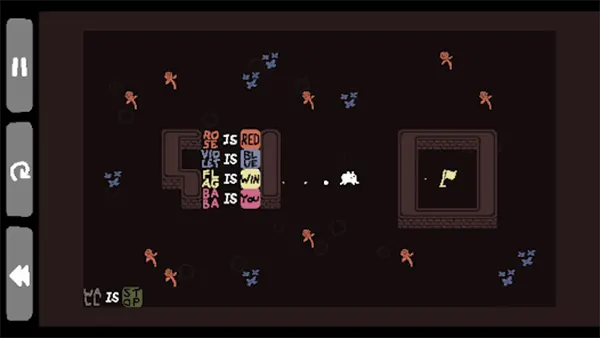
Most mobile puzzle games are built around stable logic. A wall blocks movement, water causes failure, and keys open doors. Baba Is You removes this predictability by turning game rules into movable objects. Sentences such as “Wall Is Stop” or “Flag Is Win” physically exist inside the level as blocks that can be pushed, rearranged, or broken apart. Once the sentence changes, the behaviour of the world changes instantly.
This mechanic creates a rare type of puzzle design where players are not simply searching for solutions inside fixed systems. Instead, they are changing the system itself. For example, a dangerous object can become harmless, or the player character can be transformed into something completely different. In some stages, victory is impossible until the player realises that the definition of success itself can be rewritten.
The mobile version released for iOS and Android maintains the same depth as the PC and console editions. The touchscreen interface allows direct interaction with word blocks, which often feels more natural than keyboard input. Dragging pieces across the screen mirrors the physical manipulation at the heart of the gameplay, making the mobile edition surprisingly effective for complex puzzle-solving.
How the Rule System Changes Player Thinking
Baba Is You does not reward fast reactions or memorisation. Instead, it encourages analytical thinking and experimentation. Players quickly learn that every assumption should be questioned. If lava normally destroys characters, perhaps lava can become safe. If walls stop movement, perhaps walls can become passable or even controllable.
This approach forces players to think less like traditional gamers and more like system designers. The challenge often comes from understanding relationships between objects rather than overcoming obstacles directly. A single sentence adjustment can completely reshape the level structure, opening paths that previously seemed impossible.
The game also creates a strong sense of discovery because solutions rarely feel repetitive. Many mobile puzzle games eventually train players to recognise familiar patterns. Baba Is You constantly disrupts those expectations by introducing new rule interactions, hidden conditions, and layered logic combinations that evolve throughout the campaign.
How the Mobile Version Handles Complex Puzzle Mechanics
Adapting an intricate puzzle game for touchscreens can be difficult, especially when precise movement matters. The developers addressed this by simplifying interface elements while preserving mechanical complexity. Swiping controls are responsive, and the game uses clear visual spacing to prevent accidental interactions with nearby word blocks.
Screen readability also plays an important role. Since levels contain both objects and text-based rules, visual clarity is essential on smaller displays. The mobile edition uses strong colour contrast and clean typography to ensure players can identify rule chains quickly. This matters because advanced puzzles often require tracking multiple active sentences simultaneously.
Another important aspect of the mobile release is portability. Baba Is You works well in short sessions because individual puzzles vary in length and complexity. Some stages can be solved within minutes, while others require extended experimentation. Mobile devices allow players to return to unfinished ideas at any moment without losing progress or momentum.
Why Touchscreen Controls Suit Rule Manipulation
Touch input changes how players interact with puzzle spaces. On mobile devices, moving rule blocks with direct finger gestures creates a more tactile feeling than keyboard navigation. Rearranging words becomes closer to physically handling puzzle pieces rather than controlling a distant character.
This direct interaction supports the game’s conceptual design. Since the central mechanic revolves around rewriting language, dragging words across the screen reinforces the sensation of constructing and deconstructing meaning. Even simple movements can feel significant because each adjustment may redefine the entire level.
The mobile version also benefits from modern hardware performance. Animations remain smooth even during complicated rule interactions involving multiple transformations. Instant feedback is critical because players frequently test experimental combinations, and delayed responses would weaken the trial-and-error process that defines the gameplay.
Why Baba Is You Remains Relevant in 2026
Even years after its original launch, Baba Is You continues to influence puzzle game design discussions. Developers frequently reference its approach to systemic interaction and player-driven logic. In 2026, many indie puzzle games still borrow ideas related to rule manipulation, dynamic environments, and language-based mechanics introduced or popularised by the game.
The mobile market has also changed significantly since the game first appeared. Many modern mobile titles focus heavily on monetisation systems, daily rewards, or short engagement loops. Baba Is You stands apart because it delivers a complete premium experience without relying on aggressive retention mechanics. This has helped maintain its reputation among players looking for deeper single-player experiences.
The game also remains highly replayable due to its layered solutions and optional puzzle routes. Some players revisit completed stages to discover alternative rule combinations or hidden interactions. Others use the built-in level editor available on certain versions to create community puzzles inspired by the original mechanics.
What Makes the Game Important for Mobile Puzzle Design
Baba Is You demonstrated that mobile puzzle games do not need simplified mechanics to succeed on smaller devices. The title proved that players are willing to engage with highly intellectual systems on smartphones and tablets when the interface is designed carefully.
Its influence can now be seen across multiple genres. Some strategy games use dynamic rule changes inspired by its systems, while newer puzzle projects experiment with text manipulation and environmental redefinition. The game helped broaden expectations about what mobile logic games could achieve beyond traditional casual formats.
In 2026, Baba Is You remains one of the strongest examples of puzzle design built around creativity instead of repetition. Rather than testing reflexes, it challenges assumptions and encourages players to think about game rules themselves as objects that can be questioned, moved, and transformed.