
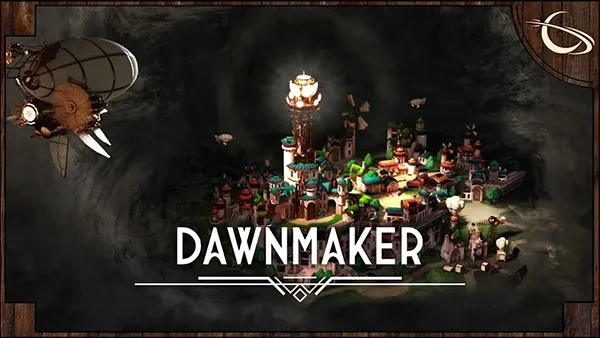






Dawnmaker Mobile is a single-player, turn-based strategy game that combines deckbuilding, city construction and resource management in a format designed to feel like a compact board game. The mobile edition arrived on Android and iOS in late 2025, bringing the complete game to phones and tablets with touch controls and interface adjustments for smaller screens. Its setting is the continent of Heksiga, where toxic Smog has covered the land and extinguished the ancient lighthouses that once protected its settlements. Each mission asks the player to establish a functioning city around one of these lighthouses, create a reliable economy, improve a growing deck of cards and produce enough Eclairium to restore the light before darkness overwhelms the settlement.
What Dawnmaker Mobile Is and How Its Campaign Works
Dawnmaker is not a conventional card battler built around direct combat with another player. Cards represent actions, economic opportunities and ways to develop the city, while buildings remain on the map and shape what can be achieved in later turns. The result is a deliberate solo puzzle in which the deck and the settlement must support one another. A strong card can solve an immediate resource shortage, but a well-placed building may continue producing value for the rest of the mission. Success therefore depends less on finding one dominant card and more on creating a stable system in which every new addition has a clear role.
The campaign is organised as a sequence of missions across Heksiga. Each region presents a different map, and natural features such as mountains, lakes, rivers or coastlines can reduce the amount of usable land. This matters because construction space is intentionally limited. The lighthouse starts with only a small illuminated area around it, and additional tiles become available as the structure is upgraded. A mission is won by improving the lighthouse to the required level, while failure occurs when the spreading darkness consumes the city. The campaign gradually adds buildings, technologies and strategic choices, allowing the rules to become more demanding without abandoning the central loop.
The story is kept concise and mainly supports the strategic objective. The player is rebuilding communities rather than commanding armies, so farms, workshops, research facilities and civic buildings are more important than weapons. Restoring a lighthouse does more than complete a level: it pushes the Smog back and returns another part of the continent to life. This gives each city a clear purpose and makes the campaign feel connected even though every mission begins with a new layout and a fresh economic problem. The tone is sombre but not relentlessly bleak, as the expanding circle of light provides a visible sign of progress.
The Core Turn-by-Turn Rhythm
A typical round gives the player three actions. Cards in hand usually require one or more actions to play, and some constructed buildings can also be activated. This simple limit creates most of the tension. Playing three inexpensive cards may provide several small benefits, while saving actions for a costly effect can produce a larger change at the right moment. Building is handled through a separate selection of available structures, but construction still depends on having sufficient industry and a suitable free tile. Because the number of actions is small, every round asks the player to identify the most urgent problem rather than complete every useful task at once.
The hand normally contains five cards, so planning involves both the visible options and the likely contents of the deck. Adding cards is not automatically beneficial. A larger deck can contain stronger effects, yet it also becomes less consistent when too many cards serve unrelated purposes. The safest approach is to select additions that reinforce the city already being built. A settlement producing plentiful science should favour cards and structures that convert science into progress, while an industry-focused plan needs enough supporting income to keep construction moving. The best decks are not simply powerful; they reliably draw useful actions at the stage when those actions are needed.
Buildings introduce a second layer of timing. Some provide resources each round, some place new cards into the deck, and others offer abilities that can be activated for a cost. Their value depends on when they are constructed and what surrounds them. An early production building may repay its cost many times, whereas the same structure built near the end of a mission may have little opportunity to contribute. Activation buildings can be decisive, but they must compete with cards for the limited action allowance. Good play comes from balancing automatic income, occasional activated effects and enough card efficiency to prevent turns from becoming clogged with choices that cannot all be used.
Building a Strong City Through Cards, Space and Resources
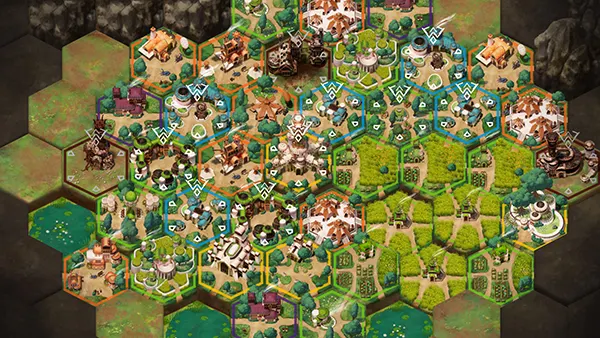
City design begins with the lighthouse at the centre of the illuminated area. Every available tile has potential value, but not every structure deserves a place. Some buildings work best beside particular neighbours, while others are useful because they support several parts of the economy at once. Placing the first structures without considering later expansion can create awkward gaps or block valuable combinations. It is usually better to reserve flexible central positions for buildings with adjacency effects and place self-contained producers closer to the edge. The correct layout changes with the map, so rigid building patterns are less reliable than reading the terrain before committing scarce space.
Resources form an interconnected chain. Farms support basic growth, industry enables construction, science helps develop advanced options, and the population must be inspired to create Eclairium, the rare material required for lighthouse upgrades. A city that produces large amounts of one resource but neglects the others can still stall. For example, strong industry is ineffective when the market offers useful buildings but the settlement lacks space, while plentiful science has limited value if the deck contains no efficient way to spend it. The practical objective is not to maximise every total. It is to produce enough of each required resource at the moment when the next stage of development becomes possible.
Lighthouse upgrades are the main milestones in a mission. Each improvement pushes the Smog away, reveals more usable land and expands the range of buildings that can appear. This creates an important strategic choice: spend resources on making the current city more efficient, or direct them towards the next lighthouse level as soon as possible. Upgrading too early may expose additional space without providing the economy needed to use it. Waiting too long can allow darkness to become dangerous and waste turns on production that no longer supports the winning condition. The strongest runs usually alternate between consolidation and expansion rather than pursuing only one of them.
Practical Strategy for Early and Later Missions
In the opening rounds, consistency matters more than ambition. The city needs a dependable source of basic resources and at least one route towards industry, because construction is the main way to improve long-term output. Cards that provide a modest immediate gain can be more useful than expensive effects that require an economy not yet established. It is also sensible to study the building market before spending. If the available structures favour science, food production or activations, the early deck can be shaped around that direction. Dawnmaker rewards adaptation, and forcing a preferred plan when the mission offers poor support usually creates unnecessary difficulty.
Space should be treated as a resource from the first turn. Before placing a building, consider what might need to stand next to it later and whether the position blocks access to a larger cluster of tiles. Natural obstacles make this especially important on irregular maps. A structure with no adjacency requirement can occupy an isolated tile, preserving connected areas for combinations. It is also worth checking whether a proposed building improves the current engine or merely adds another option. A crowded city full of individually useful structures can perform worse than a smaller settlement whose buildings repeatedly support the same resource cycle.
Later missions place greater pressure on deck quality and timing. By then, the player has access to more technologies, starting configurations and building choices, but additional variety can make decisions less forgiving. Removing weak links is as important as gaining stronger tools: when several cards perform the same job, keep the versions that fit the action economy and resource plan most efficiently. Near the final lighthouse upgrade, calculate what is still required and stop investing in systems that will not repay their cost before the mission ends. A precise final sequence is often safer than continuing to expand simply because more land or buildings are available.
Mobile Version, Controls and Who the Game Suits
The Android and iOS editions preserve the complete strategic structure while adapting interaction for touchscreens. Cards can be selected without a mouse, building controls are arranged around the board, and information is presented through panels that suit shorter mobile sessions. Early updates in January 2026 addressed accidental confirmations, board resizing and the position of the building activation button, showing that the mobile interface received specific attention after release. The turn-based design also suits touch play because nothing demands fast reactions. Players can pause over a hand, compare building options and check resource totals before committing an action.
A larger phone makes card text and board details easier to read, while a tablet provides the most comfortable overview of a developed city. The visual style uses clear shapes and icons alongside colour, and the iOS listing identifies support for distinguishing information without relying on colour alone. Even so, Dawnmaker contains several overlapping systems, so the first sessions require careful reading. The tutorial introduces the basics, but understanding why a city failed often comes from reviewing earlier choices: an overcrowded deck, delayed industry, poor placement or an upgrade attempted without enough support. This learning process is central to the game rather than a flaw to be bypassed.
Dawnmaker is best suited to players who enjoy solo board games, compact city builders and deckbuilding based on efficiency rather than combat. It does not focus on competitive rankings, rapid matches against strangers or constant collection events. The appeal lies in solving a self-contained economic puzzle, seeing a city become more capable and refining decisions over repeated missions. Sessions are thoughtful rather than passive, yet the rules remain approachable because the same core questions return throughout the campaign: which card should be played, which building deserves space, which resource is currently limiting progress and when the lighthouse is ready to advance.
Availability, Requirements and Value in 2026
As of 2026, Dawnmaker is available as a paid game on Google Play and the Apple App Store, with Acram Digital listed as the mobile publisher and Arpentor Studio credited as the original developer. The iOS edition supports iPhone and iPad devices running iOS or iPadOS 13.0 or later and has a listed download size of roughly 151 MB, although the installed size may change with updates. Android compatibility is determined by the device through Google Play. Prices differ by country, tax rules and store settings, so the current local listing is more reliable than a fixed figure quoted in an article.
The mobile release is presented as a complete solo game rather than a free download built around recurring purchases. That makes its value easier to judge: the purchase covers the campaign, the deckbuilding system, city layouts and the progression through restored regions. The amount of replay value depends on how much a player enjoys improving scores, trying alternative development paths and working with different starting conditions. Those seeking an endless stream of new competitive content may find the scope restrained, while players who prefer a defined strategy game with a clear objective are more likely to appreciate its focused design.
For a first playthrough, it is sensible to allow the campaign to teach its systems gradually rather than searching for a fixed solution to every map. Read card effects before adding them, keep the deck aligned with the city’s strongest resource engine and leave room for later building combinations. When a mission fails, identify the first point at which production fell behind instead of concentrating only on the final turn. Dawnmaker becomes much easier to understand when viewed as one connected machine: cards create opportunities, buildings turn those opportunities into lasting output, resources support lighthouse upgrades, and each restored light opens the way to the next part of Heksiga.