





LUMINES REMASTERED reached iOS and Android on 30 July 2026, bringing a puzzle design that began on the PSP more than two decades ago to devices built around touch rather than physical buttons. The basic rules remain remarkably simple: two-colour blocks fall onto a rectangular field, matching sections are arranged into single-colour squares, and a moving Timeline clears completed formations as it crosses the screen. What makes the smartphone edition interesting is not a radical rewrite of those rules. The difference comes from the way music, timing and direct finger input interact with them. A game once closely associated with handheld buttons now asks players to slide, rotate and place pieces on the same screen that displays the puzzle, while its soundtrack continues to determine the rhythm of each stage. The result still feels unmistakably like LUMINES, but playing it on a phone changes how quickly decisions are made, how the board is read and how closely the player notices the relationship between sound and movement.
Why LUMINES REMASTERED Feels Different on a Phone
The 2026 mobile release is a full adaptation rather than a separate simplified spin-off. Enhance and Sound Games brought LUMINES REMASTERED to iPhone, iPad and Android devices with the central modes and progression structure intact. There are 40 stages built around different combinations of music, block appearance, background animation and pace. Challenge Mode remains the main continuous form of play, while Time Attack provides fixed sessions of 60, 180 or 300 seconds. Puzzle and Mission modes introduce specific objectives, VS CPU creates an opponent-based variation, and local 2P Battle allows two players to compete on a shared device setup where supported. Online leaderboards and cloud saving are also included. For someone familiar with the 2018 remaster on console or PC, this means the phone edition is recognisable from the first few minutes rather than being a reduced interpretation designed only for brief casual sessions.
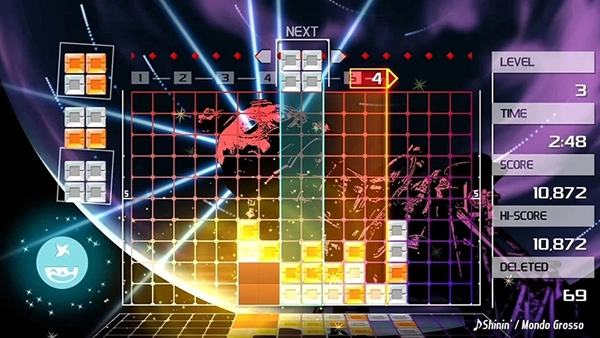
The basic puzzle itself is easy to understand without treating LUMINES as a technical exercise. Every falling piece consists of four smaller blocks arranged as a two-by-two square, with each small block using one of two colours. The player moves and rotates the piece while it falls, trying to create an area of at least two blocks by two blocks in the same colour. Completing such a square does not immediately remove it. Instead, it remains on the field until the Timeline reaches it. This delay is the defining difference between LUMINES and many familiar falling-block games. A successful placement is therefore only the beginning of a scoring opportunity. During the short interval before the Timeline arrives, more blocks can be connected to the completed area, potentially creating a much larger clear from a single sweep.
On a smartphone, this familiar rule becomes more immediate because input takes place directly on the display. There is no physical separation between looking at a falling block and controlling it. A finger moves over the same area in which the next decision is being judged, so small movements can feel quicker and more instinctive once the control scheme becomes familiar. At the same time, the smaller display encourages a different reading of the board. On a television or monitor, it is easy to scan the entire field while keeping the next pieces in peripheral view. A phone places everything in a more compact visual space. That can make the changing colours and animated backgrounds feel stronger, but it also means the player benefits from keeping the stack organised rather than relying on last-second corrections near the top of the field.
Music Is Part of the Rules, Not Background Decoration
The soundtrack is one of the reasons LUMINES cannot be described accurately as a conventional block puzzle with music added afterwards. Each stage, traditionally called a skin within the series, links its track to the visual design and the behaviour of the Timeline. The mobile edition contains 40 stages covering house, trance, techno and related electronic styles, ranging from relatively calm tracks to much more energetic sequences. Music therefore provides more than atmosphere. As the stage changes, the player hears a different beat, sees a new visual treatment and has to adjust to a different rhythm of clearing blocks. Skin Edit mode even allows unlocked stages to be arranged in a selected sequence, making the progression feel closer to a personalised set of tracks than a fixed run through identical puzzle boards.
The relationship between tempo and play becomes clear after moving between a slow stage and a fast one. A faster track generally means the Timeline completes its sweep more quickly, so completed squares are removed sooner. That can be useful when the field is becoming crowded because empty space returns rapidly, but it also reduces the amount of time available to extend several completed squares into a larger scoring sequence. A slower stage creates the opposite problem. The player has more time to build connected areas before the next sweep reaches them, yet completed blocks remain on the field for longer. If pieces continue to accumulate while the Timeline is still travelling across the board, the stack can rise surprisingly quickly. Neither tempo is automatically easier; each changes the type of pressure the player has to manage.
Sound effects reinforce this connection. Moving, rotating, dropping and clearing pieces produce sounds that sit within the musical arrangement rather than feeling entirely separate from it. As a session develops, routine inputs can start to resemble another layer of the track. Headphones make this relationship particularly clear on a phone because external noise is reduced and the stereo mix becomes easier to follow. Compatible devices can also use vibration, adding physical feedback to the rhythm and puzzle action. None of these features changes the fundamental rule for making a square, yet together they affect how players judge time. Instead of looking only at the Timeline to estimate when a clear will occur, experienced play gradually becomes tied to the beat itself, allowing the soundtrack to act as an informal clock.
How the Timeline Changes Every Decision
The Timeline is the mechanic that gives LUMINES its unusual sense of anticipation. In many block puzzles, making the required pattern produces an immediate result: a row disappears, pieces fall and the board changes. LUMINES deliberately inserts a waiting period. Once a single-colour square has been created, it stays in place until the sweeping line reaches it. During those seconds, the player can keep adding matching blocks. A modest two-by-two formation might therefore grow into a wider group before it is removed. This turns placement into a question of timing as well as shape. The player is not simply asking where the current piece fits. There is also the question of how much can be added before the Timeline reaches that part of the board and closes the scoring window.
Position on the field matters for the same reason. A square completed just behind the Timeline may remain untouched until the line travels across the rest of the board and begins another sweep. That provides a relatively long period in which to extend it. A square completed directly in front of the moving line may have only a moment before it starts being cleared. Good play therefore involves watching two things at once: the falling piece and the position of the Timeline. This does not require calculating exact timings or memorising numbers. The mechanic becomes readable through repeated sessions. Players begin to recognise when there is enough time for another block, when an ambitious extension is becoming risky, and when it is safer to use upcoming pieces elsewhere.
The Timeline also prevents a simple assumption that faster clearing always makes the game easier. A rapid sweep removes successful combinations quickly and can keep the board relatively open, but it gives the player less time to combine several completed areas into one large scoring sequence. A slower sweep makes bigger preparations possible, yet every block waiting to be cleared continues occupying space. This creates one of the central trade-offs in LUMINES: scoring efficiently and surviving do not always require the same move. A placement that extends a large group may improve the potential score while allowing the stack to climb dangerously high elsewhere. On a phone, where sessions often begin with the intention of playing for only a few minutes, this constant balance gives even a short round a clear strategic shape.
Why Short Mobile Sessions Still Have Strategic Depth
Time Attack is especially well suited to understanding how the Timeline affects short sessions. The mobile trial includes the full 60-second version, so a new player can see the relationship between placement, tempo and clearing without committing to a long Challenge run. One minute is enough for several Timeline sweeps, but not enough to recover casually from repeated poor placements. The pressure comes from using each sweep effectively. Building only isolated two-by-two squares may keep the board manageable, while preparing larger connected areas can produce a better score if the timing works. Because the session has a fixed end point, the final seconds also change priorities: long-term board organisation matters less when there is only enough time for one more useful sweep.
Challenge Mode creates a different rhythm because survival and adaptation matter over a longer period. Stages change, bringing new music, colours and Timeline speeds, so a comfortable pattern from one skin may become awkward in the next. The player has to adjust without rebuilding the board from scratch. A tidy arrangement becomes valuable because it provides room to react when the tempo changes. This is also where the musical structure has its strongest practical effect. After enough time with a particular stage, the player may become used to the interval between sweeps, only for the next track to alter that expectation. The game remains mechanically simple, but the change in tempo can make familiar placements suddenly feel too slow or too hurried.
Puzzle and Mission modes use the same underlying pieces for more focused problems. Instead of concentrating purely on survival or score, they ask the player to construct particular shapes or meet specific conditions within the available time. These modes are useful because they reveal possibilities that can be missed during ordinary play. A player who normally reacts to whatever falls next begins to notice how rotation, colour arrangement and the order of placements can create planned structures. VS CPU and local 2P Battle add another type of pressure because progress is measured against an opponent rather than only the player’s own stack. Across these modes, the mobile edition retains enough variety for brief sessions without changing LUMINES into a collection of unrelated mini-games.
Touch Controls Make Familiar Rules Feel New
The major practical change in the 2026 release is control. Previous editions were designed primarily around directional inputs and buttons, while the smartphone version provides several touch layouts and also supports a gamepad. Touch input changes the physical relationship with each piece. Moving left or right can be handled through direct screen gestures or the selected on-screen arrangement, while rotation and faster dropping are assigned to touch actions according to the chosen layout. The important point is that the player is no longer pressing controls positioned away from the puzzle. The hand operates directly over the visual area. For slow, deliberate placements this can feel natural, especially when sliding a piece across several columns, but rapid corrections require more care because an unintended gesture can have a larger effect than a mistaken button press.
There is also a difference in visual attention. Physical controls allow both hands to operate without covering any part of the image. On a phone, a thumb or finger inevitably occupies part of the display during input. LUMINES works reasonably well with this arrangement because its pieces use a regular two-by-two shape rather than many different outlines, so recognising the current piece does not require studying a complicated silhouette. Even so, players who build tall stacks near the top of the board may find precise placements harder when movement becomes rapid. The best adjustment is usually not faster finger movement but earlier decision-making: reading the next piece, choosing the intended column before it falls too far and avoiding unnecessary corrections at the last moment.
The availability of several touch layouts matters because there is no single arrangement that feels equally natural to every player. Someone accustomed to the PSP, Switch or a conventional controller may initially prefer visible controls that correspond more closely to familiar directional and rotation inputs. Another player may find gesture-led movement faster because it reduces the need to target small virtual buttons. The gamepad option remains useful for longer sessions or for players who want the precision of physical controls, but touch is not treated simply as an emergency substitute. The mobile edition was specifically reworked for phone and tablet input. That makes learning the touch scheme part of the adaptation rather than an obstacle that has to be bypassed before the original game can be enjoyed properly.
What the 2026 Mobile Version Preserves — and What It Changes
What survives the move to smartphones is more important than what has been altered. The two-colour pieces, square-building rule, Timeline, music-led stage changes and pressure of managing limited vertical space are still the centre of LUMINES REMASTERED. The 40 stages remain tied to distinct tracks and visual identities, and the familiar modes provide different uses for the same small set of rules. Progress can be stored through cloud saves, while online leaderboards give score-focused players a reference beyond their own local results. The mobile release therefore does not need a new progression system or radically different puzzle pieces to justify itself. Its main change is contextual: the same design can now be played on a device that is already carried throughout the day.
The release model also makes the structure relatively easy to assess before paying for the full game. The app can be downloaded without charge, with the first 15 levels of Challenge Mode and the complete 60-second Time Attack available as the trial portion. That is enough play to understand the two-colour block system, experience multiple music changes and decide how comfortable the touch controls feel. Unlocking the complete game is handled through a single in-app purchase rather than a progression system based on repeated consumable payments. Availability and local pricing can differ by store region, so the current listing on the device remains the appropriate place to check the final cost. For players comparing the phone edition with an older console or PC copy, the trial also provides a practical way to judge the new controls before committing to another version.
The first weeks after release also show that the mobile edition is still being maintained rather than left in its launch state. On iOS, version 1.0.3 was issued on 17 August 2026 after earlier updates, with the release notes including a fix for a cloud-versus-local-save reset problem as well as other improvements. That is relevant because cloud progression is one of the conveniences that makes a phone and tablet version useful across more than one device. More broadly, LUMINES REMASTERED on smartphones demonstrates how a classic puzzle can change without changing its central rule set. Music remains the measure of time, the Timeline still decides when successful patterns disappear, and two colours still create almost all of the strategic possibilities. Touch simply places those decisions under the player’s fingers, making a familiar twenty-year-old design feel slightly different every time the beat, the sweep and the next gesture meet.