







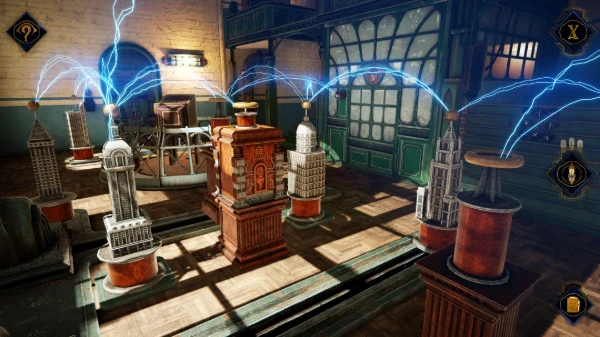
The House of Tesla brings an unusual combination of mechanical puzzles, electrical experiments and historical mystery to smartphones and tablets. Developed by Blue Brain Games, the creators of The House of Da Vinci trilogy, this adventure places players inside Nikola Tesla’s abandoned Wardenclyffe facility, where forgotten inventions conceal the story of his ambitious experiments. Released for iOS and Android on 20 October 2026, The House of Tesla: Definitive Edition features five chapters, redesigned challenges and touchscreen controls. Its most distinctive feature is a special device that makes invisible electrical currents visible, allowing players to investigate machines and alter the movement of electricity to solve increasingly complex puzzles.
How Electrical Mechanisms Work in The House of Tesla
Electricity is central to the game’s puzzles rather than simply a visual theme. Players encounter machinery that cannot be operated through ordinary mechanical adjustments alone. Certain mechanisms depend on electrical energy reaching the correct components, while others require a closer examination of how different parts interact. The challenge involves understanding the relationship between a machine’s visible construction and its hidden electrical behaviour. Instead of presenting conventional questions about voltage or resistance, the game turns these ideas into interactive problems that can be approached through observation, experimentation and logical reasoning.
The main tool for investigating electrical mechanisms is a fictional handheld prototype. This invention allows players to visualise electrical currents that would otherwise remain invisible and influence their movement. It changes how machinery can be examined, revealing an additional layer of information beyond the switches, rotating components and physical controls visible in a room. A mechanism that initially seems inactive may become understandable once its electrical connections are examined. The prototype is therefore more than a convenient puzzle-solving accessory: it provides a different way of interpreting the surrounding environment.
Mechanical and electrical interactions frequently form parts of larger challenges. Activating one component may be necessary before another mechanism becomes useful, while changes to an electrical system can help explain why a particular machine remains inactive. Players must consider how individual elements contribute to the intended result rather than manipulating every available control at random. This creates a distinction between noticing an interactive object and understanding its purpose. The most effective approach is to examine the construction of a device, identify its apparent function and determine how the electrical system might affect its operation.
Using the Prototype Device to Understand Electrical Connections
The prototype introduces an important distinction between seeing a mechanism and understanding how it functions. Ordinary exploration reveals physical details such as panels, switches, moving elements and connections between different sections of a machine. Activating the prototype provides information about the electricity associated with those mechanisms. Players can then compare what they see in both views and identify relationships that were not immediately apparent. This approach encourages careful investigation because the visible construction of a device does not always reveal everything required to operate it.
When an electrical puzzle proves difficult, the useful first step is to establish which elements can be examined or manipulated. Players should pay attention to the parts that appear connected and consider whether the prototype reveals a reason for their current state. Changing one element at a time makes it easier to recognise the consequences of an action. If several adjustments are made without examining their effects, it becomes difficult to determine which change actually matters. A deliberate sequence of observations and experiments is usually more productive than repeatedly trying different combinations without understanding the mechanism.
The prototype also gives the game a scientific character without demanding specialist knowledge. Its representation of electricity is designed around puzzle-solving rather than accurate electrical engineering calculations. Players do not need to memorise formulas, measure current or understand the detailed operation of historical generators. The important skill is recognising relationships between components and learning how an electrical change affects a machine. This distinction makes the puzzles accessible to a broad audience while preserving the satisfaction of solving problems through experimentation. The device represents a fictional interpretation of electrical manipulation, not a simulation of technology available during Tesla’s lifetime.
Scientific Puzzles and Their Connection to Nikola Tesla’s Inventions
The House of Tesla draws much of its identity from the inventor’s work on electricity and wireless energy transmission. Its principal setting, Wardenclyffe, was a genuine experimental facility established in Shoreham, New York, during the early twentieth century. Tesla intended the site to support ambitious communications and wireless power projects, although his wider plans were never realised. The game uses this unfinished endeavour as the foundation for a fictional mystery. Players investigate deserted industrial spaces, examining machines associated with Tesla’s scientific ambitions and uncovering events connected to the facility’s decline.
Rather than reproducing historical experiments in precise technical detail, the developers reinterpret scientific concepts as handcrafted challenges. Electrical transmission, mechanical movement and the interaction between connected components provide the foundation for puzzles that fit naturally into the industrial surroundings. This design allows the scientific theme to influence how problems are solved without turning the adventure into an educational examination. The player is encouraged to think about the intended purpose of an invention and the conditions necessary for it to operate. The historical inspiration gives these mechanisms a recognisable context, even when their fictional capabilities go beyond real engineering.
The game’s five chapters gradually develop this relationship between exploration and problem-solving. Locations include spaces inspired by Tesla’s personal office, factory buildings, laboratories and the famous Wardenclyffe Tower. Each environment presents machinery and objects that contribute to the wider mystery. Progress depends on examining these surroundings, solving interconnected puzzles and recognising details that may become important later. The Definitive Edition also includes substantial revisions to the original experience, with improved chapter progression and a completely rebuilt Tower chapter. These changes were introduced after player feedback and form part of the mobile release.
How Observation and Logical Reasoning Help Solve Difficult Puzzles
Many challenges require players to understand the purpose of a mechanism before attempting to operate it. A useful method is to separate the problem into three questions: what is the machine supposed to achieve, which components appear to influence that result, and what information is still missing? This prevents unnecessary experimentation and helps establish a clear objective. If a mechanism contains several interactive elements, their arrangement may provide clues about the intended sequence of actions. Examining the surrounding equipment can also reveal whether the solution depends on something elsewhere in the room.
Close inspection is particularly important because The House of Tesla combines physical manipulation with electrical investigation. A mechanism may contain an ordinary mechanical element and an electrical feature that must be considered together. Players who concentrate exclusively on visible buttons or rotating parts risk overlooking information revealed by the prototype. Conversely, focusing only on electrical connections can mean missing an important physical adjustment. Alternating between these perspectives helps establish a more complete understanding of the puzzle. It is also worth revisiting previously examined objects after operating nearby machinery, since their relevance may become clearer as the situation changes.
Some of the more demanding puzzles involve several stages of reasoning rather than a single correct action. Solving an initial mechanism may reveal another component, provide access to a new area or clarify the purpose of an earlier discovery. The game includes an updated hint system for situations where progress becomes difficult. These hints are useful when players have thoroughly inspected the available mechanisms but cannot identify the next step. Nevertheless, attempting to understand the relationship between components before requesting assistance makes the solution more meaningful. The challenge is generally about interpreting the available evidence, not possessing advanced scientific knowledge.
How the Mobile Version Adapts Tesla’s Puzzles for Touchscreens
The House of Tesla: Definitive Edition became available on iPhone, iPad and Android devices on 20 October 2026, following the original PC release in September 2025. Blue Brain Games adapted the adventure for touchscreen interaction rather than simply introducing a smaller display for an existing computer game. Players can examine three-dimensional environments and interact with mechanisms through touch-based controls. This is particularly important for a puzzle adventure built around investigating objects and making precise adjustments. The mobile edition also incorporates the revised chapters, improved presentation and redesigned finale introduced in the Definitive Edition.
Touchscreen interaction makes the game’s physical puzzles feel more immediate, particularly when examining machinery at close range. Manipulating an object with a finger creates a different experience from using a mouse, although the underlying logic of the challenges remains unchanged. Screen size can influence how comfortably players recognise small components or investigate detailed installations. A tablet offers more room for examining elaborate mechanisms, while a smartphone makes the adventure easier to play away from a desk. Regardless of device, taking time to inspect the surroundings is important because visual details frequently help explain the next required action.
The mobile release is a premium purchase priced at £6.99 in the United Kingdom, with equivalent launch prices of €6.99 and $6.99 in the relevant markets. On Apple’s App Store, one purchase provides access across compatible iPhones, iPads and Macs. The iOS version requires iOS 18.0 or later, and its listed download size is approximately 2.3 GB. Android users can obtain the game through Google Play, although compatibility and installation requirements should be checked against the specific device. The developer describes the complete adventure as offering more than ten hours of gameplay, with actual completion time depending on puzzle-solving experience.
Storytelling, Visual Details and the Complete Mobile Experience
The scientific puzzles are closely connected to the game’s narrative. Through flashbacks, players witness important moments associated with Tesla’s ambitions and the development of Wardenclyffe. Diary entries and environmental details provide additional context, gradually explaining the circumstances behind the abandoned facility. The story is a fictional interpretation of historical events, not a documentary account of Tesla’s life. Its purpose is to give meaning to the machinery encountered during exploration and explain why particular locations matter. This connection between narrative and puzzles makes progress feel like an investigation rather than a collection of unrelated mechanical tasks.
The Definitive Edition improves the visual presentation through revised models, textures, lighting and sound design. These changes matter because the industrial environments are not merely decorative backgrounds. Machinery, architectural details and the arrangement of objects help players understand where to investigate and how different mechanisms may relate to one another. Atmospheric lighting also supports the abandoned laboratory setting, while the reconstructed final chapter gives the adventure a more carefully developed ending. The game features English and Czech voice acting, alongside interface and subtitle options in ten languages, including English, French, German, Italian, Spanish and Polish.
The House of Tesla is most suitable for players who enjoy patient exploration, mechanical reasoning and puzzles that require several observations before a solution becomes apparent. Its electrical prototype distinguishes it from conventional escape-room adventures by making invisible currents part of the investigative process. The mobile adaptation preserves the central challenges while allowing them to be approached through direct touchscreen interaction. Although the fictional inventions should not be mistaken for historically accurate electrical devices, their connection to Tesla’s ambitions gives the puzzles a consistent identity. For players interested in science-themed mysteries, the game offers a substantial adventure built around understanding how complex mechanisms work.