






Don’t Starve Together officially arrived on Android and iOS on 21 July 2026, bringing Klei Entertainment’s distinctive multiplayer survival game to smartphones and tablets. Adapted for mobile devices by Playdigious, the game retains the dark, hand-drawn visual style, unpredictable environments and demanding survival mechanics that made the original so recognisable. Players enter a mysterious world known as the Constant, where hunger, darkness, hostile creatures and changing seasons threaten their progress. Unlike survival games that focus primarily on individual achievements, Don’t Starve Together encourages players to establish settlements, divide responsibilities and manage shared supplies. Understanding how these elements interact is essential to keeping an entire group alive, particularly when preparing for winter or organising expeditions into unfamiliar territory.
Co-operative Survival in Don’t Starve Together on Mobile
The mobile edition of Don’t Starve Together is available through Google Play and the Apple App Store as a paid game with optional in-app purchases. It should not be confused with Don’t Starve: Pocket Edition, which offers a separate single-player survival experience. The multiplayer adaptation features a redesigned interface, touchscreen controls and support for compatible controllers. Players can also link their accounts to share eligible character and cosmetic unlocks with the computer and console editions. However, shared unlocks do not mean that multiplayer sessions are compatible across all devices. As of November 2026, mobile players cannot join games hosted by PC or console users.
Every survivor must monitor three fundamental indicators: Hunger, Health and Sanity. Hunger gradually decreases throughout the day, while Health is affected by combat, starvation and environmental hazards. Sanity can decline when characters spend time in darkness, encounter disturbing creatures or experience other unpleasant conditions. When it falls sufficiently low, shadow creatures become a genuine threat. These mechanics make survival a continuous process rather than a series of isolated challenges. A player returning from an expedition with valuable materials may still require food, healing and protection before contributing to the group’s next objective.
Co-operative play makes it possible to distribute these responsibilities among several participants. One survivor can gather wood and stone while another searches for food, and a third can establish a temporary campsite. During the first few days, dividing tasks allows the group to cover more ground without neglecting essential preparations. Nevertheless, travelling separately introduces additional risks, especially as night approaches. Every participant should carry a reliable light source and sufficient supplies to survive an unexpected delay. Agreeing on a meeting point before leaving camp also prevents unnecessary searches when players become separated.
Character Selection and the Distribution of Responsibilities
The choice of character influences how a survivor contributes to the group. Wilson is a practical starting option because his abilities do not require beginners to follow an especially restrictive routine. His growing beard also provides useful insulation during colder weather. Wendy, accompanied by her ghostly sister Abigail, is particularly effective against groups of smaller hostile creatures, including spiders. Wolfgang specialises in physical combat, making him a suitable choice for players who enjoy confronting stronger enemies and protecting companions during dangerous encounters. Combining characters with complementary abilities generally produces a more adaptable group than selecting survivors solely for their individual combat strength.
Some characters are better suited to supporting the settlement’s economy. Woodie can collect timber efficiently using his special axe, Lucy, while Wickerbottom’s abilities provide access to useful knowledge and magical books. Wormwood has distinctive advantages in cultivation, although his unusual healing requirements demand additional attention. Warly brings specialised cooking abilities but cannot simply follow the same eating routine as most other survivors. These differences become increasingly important as the settlement grows, since food production, construction and combat gradually require more time than a single participant can reasonably manage.
Responsibilities should remain flexible rather than becoming permanent restrictions. A player responsible for gathering resources may need to assist with combat during a Hound attack, while the group’s cook might temporarily concentrate on collecting ice or harvesting vegetables. It is also sensible for everyone to learn essential crafting recipes and basic food preparation. A settlement that depends entirely on one specialist becomes vulnerable whenever that person disconnects or is unable to participate. The most sustainable groups combine character specialisation with enough shared knowledge to continue operating when circumstances change.
Building and Developing a Sustainable Base in the Constant
Selecting a suitable location for a permanent settlement is one of the most consequential decisions in Don’t Starve Together. A convenient campsite should provide reasonable access to trees, grass, twigs, stone and renewable food sources. Establishing a base near several different biomes can reduce the time spent travelling for materials. However, proximity to resources must be balanced against environmental dangers. Swamps contain hostile creatures and concealed threats, while areas heavily populated by spiders or other aggressive inhabitants can make ordinary activities unnecessarily difficult. Spending the opening days surveying the surroundings is often more productive than immediately constructing a permanent settlement.
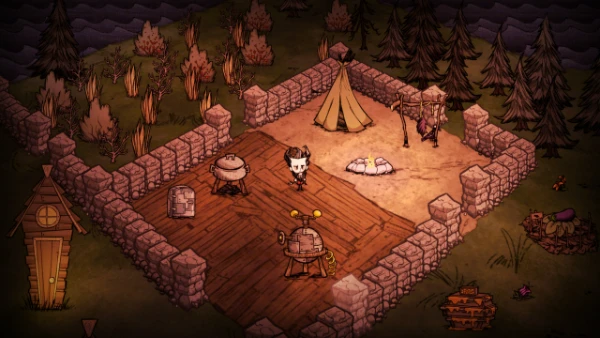
Early construction should concentrate on essential facilities rather than decorative structures or unnecessary walls. A permanent Fire Pit provides a dependable location for warmth and illumination, while the Science Machine allows survivors to prototype important equipment and construction recipes. The Alchemy Engine subsequently expands the range of available equipment, supporting more advanced preparations for seasonal changes and expeditions. Storage chests help separate construction materials from food and equipment. Placing these structures within convenient reach of one another reduces the time required for routine activities without forcing every survivor to work in the same cramped space.
As the settlement develops, food preparation becomes an increasingly important part of its infrastructure. The Crock Pot requires three Cut Stone, six Charcoal and six Twigs, together with access to the appropriate crafting knowledge. It allows four ingredients to be combined into prepared dishes, many of which offer considerably better nutritional value than eating individual ingredients. An Ice Box slows the deterioration of stored food, making it easier to maintain supplies between expeditions. These structures should take priority over cosmetic improvements because their benefits are shared by the entire group and remain relevant throughout subsequent seasons.
Seasonal Preparation and Settlement Protection
Under standard world settings, a new game normally begins in autumn, giving survivors approximately 20 in-game days before winter arrives. This initial period is particularly valuable because temperatures are relatively manageable and several common food sources remain accessible. Preparing for winter involves more than collecting a large quantity of berries or meat. Food can spoil, crops and other resources behave differently during colder conditions, and survivors require protection against freezing. Crafting warm clothing, preparing Thermal Stones and maintaining an adequate fuel reserve should therefore become priorities before the first substantial temperature drop.
Spring and summer introduce different challenges. Frequent rainfall during spring increases wetness, which can affect Sanity and complicate everyday activities. Appropriate rain protection makes gathering resources considerably easier. During summer, overheating and spontaneous smouldering threaten both survivors and structures under standard conditions. An Endothermic Fire Pit provides cooling, while Ice Flingomatics can protect nearby structures against fire-related hazards. Groups should consider these requirements when arranging their settlement, rather than waiting until extreme weather makes construction and resource collection more difficult.
Protection against hostile creatures requires similar foresight. Periodic Hound attacks can interrupt farming, cooking and construction, particularly when several survivors are present. A separate combat area away from valuable structures reduces the likelihood of damage during defensive encounters. Players should keep spare armour, weapons and healing supplies accessible to the entire group. Seasonal bosses such as Deerclops present a more serious threat because they can cause extensive damage to buildings. Moving dangerous encounters away from the settlement is generally preferable to fighting beside storage chests, crafting stations and accumulated food reserves.
Resource Management, Food Production and Group Progression
Resource management in Don’t Starve Together involves maintaining a balance between immediate consumption and future requirements. Grass and twigs are needed for basic equipment, logs serve as construction materials and fuel, while rocks and gold contribute to more advanced crafting. Spending an entire stockpile on a single construction project can leave the settlement without enough materials for emergency equipment. Separating everyday supplies from reserves intended for major improvements helps prevent this problem. Players should also replace frequently consumed materials before shortages interrupt essential activities, particularly when several participants draw from the same collection of resources.
Food production becomes more manageable when survivors combine gathering, hunting and cultivation. Berry bushes can be transplanted and fertilised, while farming provides access to vegetables that support numerous Crock Pot recipes. Meat obtained from hunting can be combined with suitable ingredients to prepare more substantial meals. Meatballs, for example, can be produced using one piece of suitable meat and three compatible fillers, such as berries. A fresh serving restores 62.5 Hunger, making it useful for routine survival. Dishes such as Pierogi, which restore 40 Health when fresh, are particularly valuable for survivors recovering from combat.
Shared storage should reflect the practical needs of the group. Frequently used materials belong near crafting stations, while perishable ingredients should remain in suitable food storage until required. Keeping separate reserves of healing items, armour and fuel allows players to respond quickly to unexpected threats. A simple arrangement of designated chests is generally sufficient; an elaborate inventory system is unnecessary for a small group. What matters is that everyone understands where essential supplies are kept and avoids consuming materials already reserved for upcoming construction projects or seasonal preparations.
Organising Expeditions and Maintaining Long-Term Co-operation
Once a settlement can reliably support its inhabitants, expeditions offer opportunities to obtain less common resources and investigate new areas. Underground caves contain valuable materials, unusual creatures and additional survival challenges, while ocean travel provides access to islands and other locations beyond the mainland. Before departure, players should prepare suitable equipment, portable food, light sources and healing items. Expedition supplies must be calculated with the return journey in mind, since unfamiliar routes and unexpected encounters can considerably extend the time spent away from the main settlement.
Character death does not necessarily end an individual’s participation in a multiplayer world. Survivors can become ghosts and may return to life through revival methods such as a Telltale Heart provided by another player. Resurrection can carry penalties depending on the method used, making preventative preparation more efficient than repeatedly reviving fallen companions. Groups should maintain enough materials for emergencies and avoid leaving inexperienced players without support in dangerous locations. Recovering equipment from the site of a previous death should also be treated as a planned expedition rather than an immediate obligation.
Long-term progress depends on maintaining a settlement capable of supporting increasingly ambitious activities without exhausting its inhabitants. Advanced crafting, boss encounters, exploration and agricultural improvements all compete for the same supplies and players’ time. Establishing clear objectives for each session helps prevent several expensive projects from being started simultaneously. The mobile edition of Don’t Starve Together retains this emphasis on collective planning, allowing players to develop a persistent survival routine suited to their group’s availability. A successful settlement is ultimately defined not by its size, but by its ability to withstand seasonal hazards, replenish essential resources and support every survivor when unexpected difficulties arise.